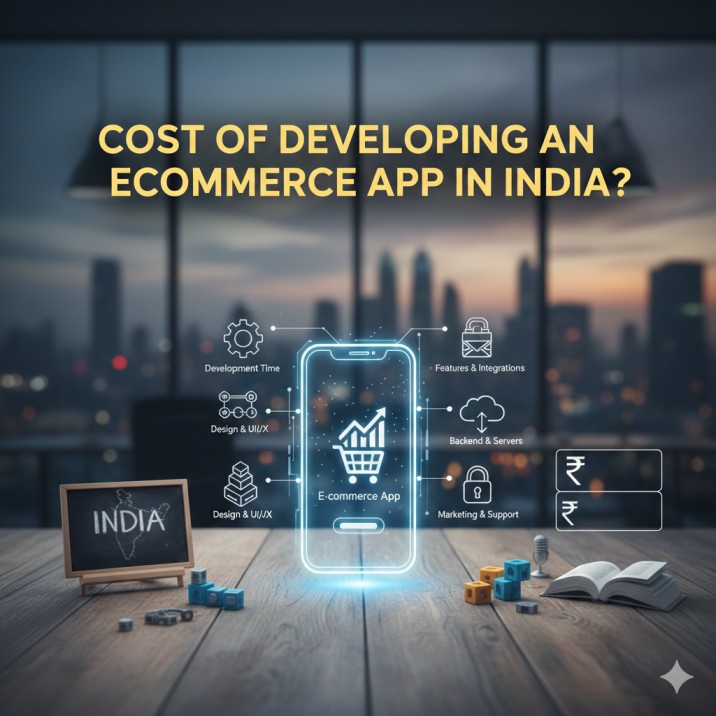
If you’re planning to take your retail business online or launch a new digital storefront, one of the first—and most important—questions is: “What is the cost of developing an ecommerce app in India?” The answer isn’t just a number; it depends on factors like app complexity, features, platform choice, design sophistication, and whether you plan for future growth. In 2025, ecommerce apps are more essential than ever, and understanding the cost structure helps you budget wisely and avoid surprises.
Below, we break down how much it typically costs to build an ecommerce mobile app in India, what affects the price, side-by-side comparisons, and practical strategies to get high value for your investment.
How Much Does an Ecommerce App Cost to Build in India?

| App Type | Approx. Cost Range (INR) | Typical Timeline |
|---|---|---|
| Basic Ecommerce App | ₹3,00,000 – ₹8,00,000 | 3–4 months |
| Mid-Range Ecommerce App | ₹8,00,000 – ₹15,00,000 | 4–6 months |
| Complex Ecommerce App | ₹15,00,000+ | 6–10+ months |
This table represents ballpark estimates for app development in India based on current market observations. Actual costs vary depending on specific requirements, tech stack, and development team rates. These figures are for custom mobile app builds, not simple website or template-based solutions.
Why Does Ecommerce App Development Cost So Much?
Before we go into deeper detail, it’s important to understand why costs vary so widely. Multiple elements influence your total development spend:
1. App Complexity
The more features your app has, the longer it takes to build and test. A basic ecommerce app with product listings, shopping cart, checkout, and a simple admin dashboard costs much less than a marketplace with multiple vendors, live analytics, AI recommendations, or a loyalty system.
2. Design and User Experience
Custom UI/UX design costs more than using a standard template. Great design helps with brand identity and customer retention, but it requires skilled designers and more development time.
3. Platform Choice
You can choose between:
- Android only
- iOS only
- Both native platforms
- Cross-platform frameworks like Flutter or React Native
Developing for both platforms separately increases cost, whereas cross-platform builds can save money and time.
4. Backend & Integrations
Ecommerce apps typically need a robust backend with APIs for catalog management, payment gateways, CRM integration, analytics, and secure user authentication. All these components add to the budget.
5. Third-Party Services
Payment gateways, shipping and logistics APIs, push notifications, and analytics tools all require integration work, which drives complexity and cost.
6. Development Team Model
Costs vary based on how you build your team:
- Freelancers can be cheaper but risk inconsistent quality
- Agencies offer end-to-end support
- In-house teams give full control but come with recruitment and overhead costs
Choosing the right model depends on your timeline, budget, and long-term support expectations.
Basic Ecommerce App: What You Get + Cost Breakdown
For smaller businesses or startups testing a concept, a basic ecommerce app includes:
- Product catalog
- User registration/Login
- Shopping cart
- Basic checkout
- Payment integration
- Push notifications
- Simple admin panel
💡 Typical cost: ₹3,00,000 – ₹8,00,000
💡 Timeline: 3–4 months
This is a good entry point for businesses that want a mobile presence but don’t need advanced features right away.
Mid-Range Ecommerce App: Expanded Features
A mid-range ecommerce app usually includes everything in a basic build plus:
- Order tracking
- Wishlist / favorites
- User reviews and ratings
- Filtering and search tools
- Multiple payment gateways
- Social login
- Better analytics dashboard
💡 Typical cost: ₹8,00,000 – ₹15,00,000
💡 Timeline: 4–6 months
This option is ideal for growing businesses that need more engagement features and stronger customer experience.
Complex Ecommerce App: Marketplace & Advanced Features
For enterprises or ambitious startups aiming high, a complex ecommerce app may include:
- Multi-vendor or marketplace support
- AI-powered product recommendations
- Real-time analytics and dashboards
- Loyalty/Rewards programs
- Chat support or chatbot integration
- Advanced inventory management
- Custom API integrations
- Multiple languages and currencies
💡 Typical cost: ₹15,00,000+
💡 Timeline: 6–10+ months
Apps at this level are designed to compete with established players and require senior developers and strong project planning.
Native vs. Cross-Platform vs. Headless Commerce
Native Apps
Separate Android and iOS builds with maximum performance and UX polish.
✔ Best user experience
✖ Higher cost due to two codebases
Cross-Platform Apps (React Native / Flutter)
One codebase for both platforms.
✔ Cheaper and faster
✖ Slight performance trade-offs
Headless Commerce
Uses a content management frontend with APIs feeding backend systems.
✔ Fast, scalable, and flexible
✖ Requires strong backend architecture
Each approach affects cost differently, and the choice depends on your priorities for performance, budget, and future scalability.
Post-Launch & Maintenance Costs
Developing your app is just the first step. After launch, you’ll need to plan for:
- Bug fixes
- OS and device updates
- Performance optimization
- Feature upgrades
- Server and hosting costs
- Security patches
A typical annual maintenance budget is 15–25% of the initial development cost. Factoring this in upfront helps avoid surprises and ensures your app stays competitive and secure.
Tips to Reduce Your Ecommerce App Development Cost
Here are practical strategies to optimize your budget without sacrificing quality:
🧠 Start With an MVP
Focus on essential features first. Validate assumptions with real users, then pace enhancements in future versions.
🤝 Choose Cross-Platform When Appropriate
Cross-platform frameworks like Flutter and React Native can save time and money for most ecommerce scenarios.
📊 Leverage Third-Party Tools
Instead of building everything from scratch, integrate well-supported third-party services (e.g., payment gateways, analytics).
🛠 Prioritize Features
Avoid adding advanced features upfront unless they are core to user experience or monetization strategy.
Final Thoughts
The cost of developing an ecommerce app in India in 2025 varies widely based on your business model, feature set, and technology choices. While basic ecommerce apps can be built for a few lakhs, complex marketplace solutions require significantly more planning and budget. With a clear roadmap—and the right development partner—you can build an app that serves your audience, enhances your brand, and drives long-term revenue.
Planning at each stage, setting clear goals, and phasing features intelligently are key strategies for both cost control and business success. If you’d like, I can also help you create a feature roadmap + estimated budget for your specific ecommerce app idea. Just tell me what you’re planning!
- What is the cost of developing an ecommerce app in India?
The cost of developing an ecommerce app in India typically ranges from ₹5 lakhs for a basic app to ₹50 lakhs or more for feature-rich, enterprise-grade platforms, depending on complexity and integrations.
- What factors influence the cost of developing an ecommerce app in India?
Key factors include app complexity, number of products, payment gateway integrations, UI/UX design, backend infrastructure, third-party APIs, security requirements, and post-launch maintenance.
- Is it cheaper to build an ecommerce app in India compared to other countries?
Yes. India offers significantly lower development costs due to competitive developer rates while maintaining high technical expertise, making it a cost-effective choice for global businesses.
- How can businesses reduce the cost of developing an ecommerce app in India?
Businesses can reduce costs by starting with an MVP, prioritizing essential features, using scalable cloud infrastructure, and partnering with an experienced development team that avoids overengineering.